


You might have ghosted a date, but have you ever ghosted your new boss?
According to our new survey, most people have. We asked 2,000 Americans who have switched jobs in the last two years about their ghosting habits, and more than half (53%) admitted to ghosting a new employer.
From skipped interviews to day one no-shows, we’re exploring the latest workplace ghosting trends, the risks of doing so and how workplace habits translate to ghosting in dating and friendships:
- Ghosting has entered the workplace
- Outside of work, people are most likely to ghost a friend
- Ghostlighting and other ghosting trends
- Why you should think twice before ghosting
- How employers are tackling the rise in ghosting
Ghosting has entered the workplace
If you haven’t heard of ghosting before, it’s essentially the act of cutting off communication abruptly and without explanation. The trend is huge, with over 800,000 monthly Google searches globally.
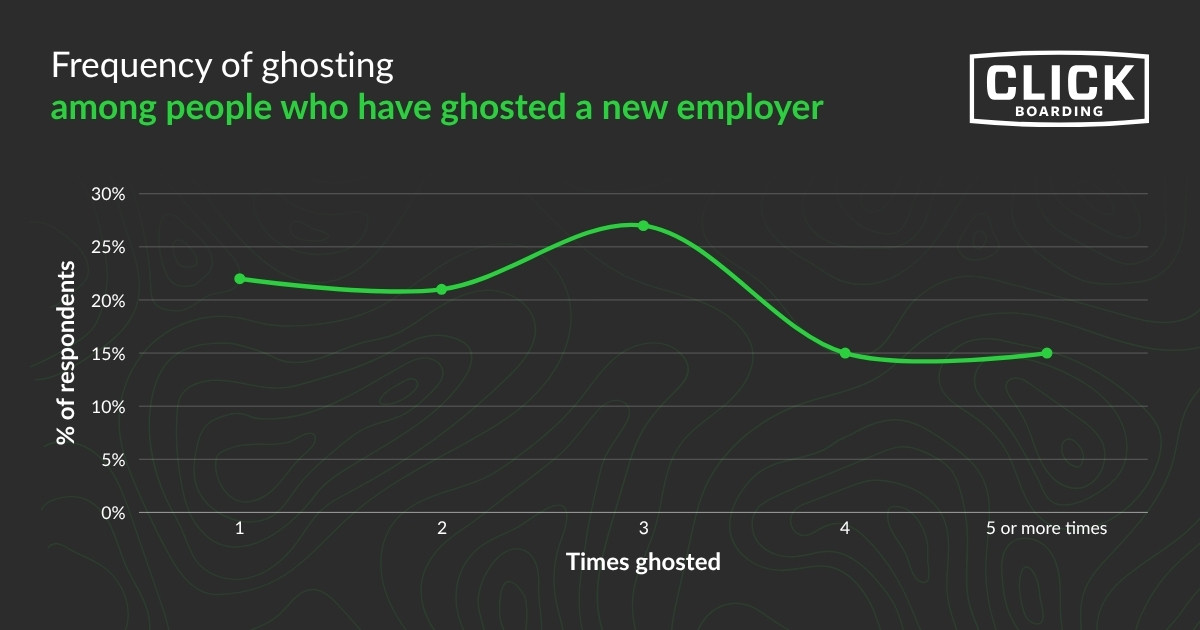
In the workplace, this is becoming a significant issue in the hiring process. With 53% of our survey respondents admitting to ghosting a new employer, 42% have done so more than once.
- Nearly a third of people (31%) who ghosted a new employer didn’t even feel guilty about it.
- 45% of people ghosted in the period between receiving a job offer and their first day.
Adam Wachtel, Click Boarding’s Chief Technology Officer, says, “Poor engagement in this window leaves a company more open to ghosting or having a candidate take a competing offer. It also sets a precedent for the rest of the employment as this is the only impression a candidate has about your company and what it’s like to work there.”
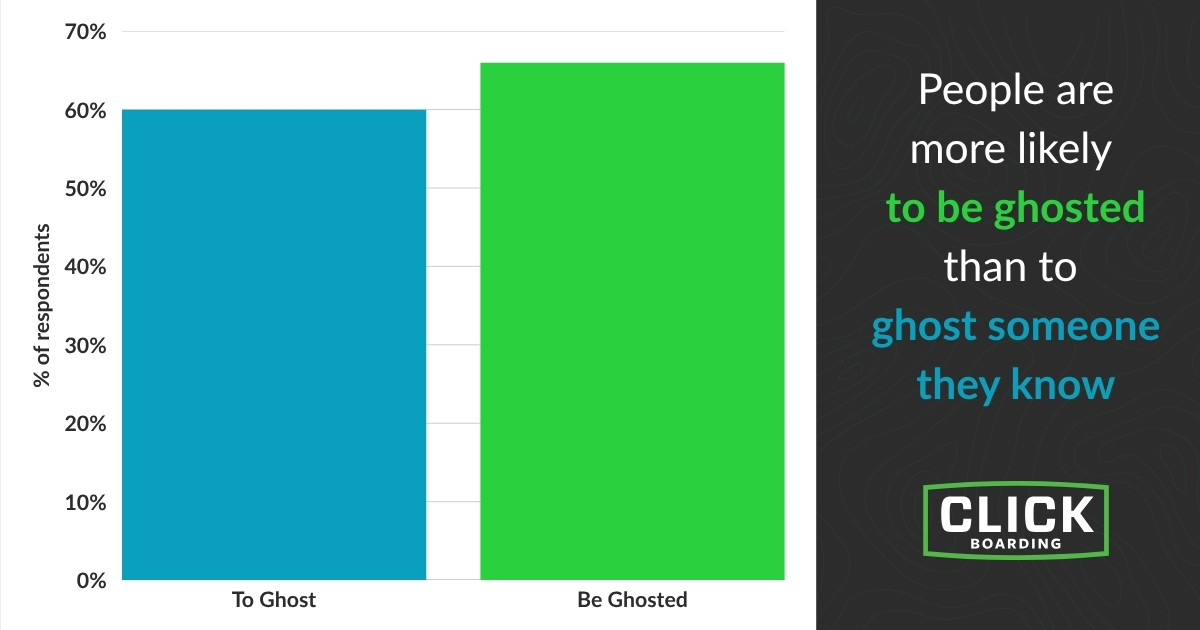
Although it goes both ways. A slightly higher number of people, 59%, told us that they had experienced ghosting from their new employer, with 45% experiencing it on multiple occasions.
Signing a contract hasn’t proved to be a guarantee either – of those who were ghosted, 36% had it happen after signing a contract, and shockingly, some people (14%) found themselves ghosted after actually starting the job.
Our survey also found that:
- Nearly half of people (49%) believe that ghosting has become an accepted part of the hiring process
- Most people (69%) think employers have a responsibility to formally reject candidates rather than ghost them, which is surprising considering the number of people openly admitting to doing this to their new employer.
Why people ghost
As for why people ghost, a third of those we surveyed said that they would rather ghost somebody than have an awkward conversation (34%). But what’s interesting is that only 9% say they’d rather be ghosted than face the awkwardness, meaning people are fine with ghosting when they’re the one doing it but not when they’re on the receiving end.
45% of people would also ghost to avoid continuing in an uncomfortable situation.
Exploring the psychology behind ghosting, a 2024 study explains this can be because “the relationship is still so new that it doesn’t seem worth the effort or discomfort to have a difficult conversation”.
In the workplace, this can be more likely with a lack of sufficient pre-employment engagement (also known as preboarding) and communication. Silence creates doubt. If candidates don’t hear from the company after accepting an offer, they often begin questioning whether the organization is organized, excited about them or even prepared for their arrival.
“Ghosting is often less about the individual being irresponsible and more about disengagement occurring before the employment relationship ever truly begins.”
Christine Marino, Chief Strategy & Transformation Officer
Without continued engagement, emotional commitment to the role weakens very quickly.
Outside of work, people are most likely to ghost a friend
Ghosting is also reshaping people’s personal lives and ghosting a friend is more common than any other type of ghost-like behavior:
- 65% of people have ghosted a friend and 51% have done so more than once.
- Ghosting a date is also high at 63%, with 49% doing so on multiple occasions.
While a lot of people admit to ghosting, that doesn’t mean they like doing so. In fact, 43% of people would rather be ghosted themselves than feel the guilt of ghosting someone else.
On average, people appear more likely to be ghosted than to ghost others, though this actually suggests that some people are unaware they’re doing it, or less willing to admit it.
The guilt creeps up in friendship ghosters. 70% of respondents said they would feel guilt from ghosting a friend, compared to 64% for a date.
It also generally happens earlier in dating than in people’s work lives. The most common time for ghosting to occur in relationships is before going on a date (30%), whereas in the hiring process, this is after receiving a job offer.
While smaller numbers, some of the other statistics are particularly shocking:
- 16% of people ghosted during a first date.
- 8% did so after making their relationship status official.
The U.S.’s biggest ghosters
Breaking down the statistics demographically, the country’s biggest ghosters differ quite a bit depending on who it is that’s being ghosted.
| Their new employer | Someone they’re dating | A friend | |
| Gender | Men (57%) | Women (65%) | Men (65%) |
| Age group | 35 to 44 (56%) | 35 to 44 (68%) | 65+ (75%) |
| State | Missouri (74%) | Kentucky (77%) | New York (76%) |
| Industry | Information, Science, Technology (63%) | Industrial, Energy, and Construction (68%) | Creative industries 71%) |
Understandably, those in older age groups will have had more opportunities to ghost – but younger generations do rank similarly throughout, with it being a more recent trend.
Millenials show the highest likelihood to ghost an employer or a date, with Baby Boomers rating most likely to ghost a friend.
High-turnover sectors like hospitality and retail (52%) and health and social care (54%) also report high levels of workplace ghosting, but the fact that rates are even higher in some industries not usually in the spotlight just shows how widespread this problem has become.
Ghosting opinions
- 44% of people would rather be ghosted in their dating life than by a new employer.
- Most people (56%) believe that ghosting in hiring feels more disrespectful than ghosting in dating.
- The same number of respondents (56%) think waiting to hear from a new employer is more stressful than waiting to hear from someone they are dating.
- Only 7% of people would feel more guilty ghosting their employer than someone they are dating.
Ghostlighting and other ghosting trends
Ghosting may have started as a simple disappearing act, but it’s now evolved into a range of related behaviors such as so-called ghostlighting and benching.

Ghostlighting
In the last 12 months, ghostlighting has become a breakout search trend in the U.S. and is a toxic combination of ghosting and gaslighting. After a previous ghosting, the ghoster tries to pick up contact in the future as though nothing happened.
Nearly two-thirds (64%) of our survey respondents say they have experienced ghostlighting before, and most of them had this happen in their dating lives (35%).
In the workplace, one in five people (21%) have been contacted by an employer who previously ghosted them, while 15% got in touch with an employer they had previously ghosted.
Only 22% would be willing to hear the employer out and the majority (56%) wouldn’t consider working for an employer who previously ghosted them.
Benching
A huge three-quarters of people (74%) have experienced benching. This trend is where, instead of full-on ghosting, the perpetrator treats someone else as a backup while they explore other options. Its name references being kept as a substitute player on a sports team’s bench.
Our survey respondents mainly experienced this as feeling strung along or sidelined by someone they were dating while they dated other people or explored other connections (37%).
Within hiring, this might include being made to believe you have gotten the job, in case a first-choice candidate doesn’t accept.
Other ghosting trends
- Alpine divorce – a bizarre and dangerous dating trend where people are being abandoned in the wilderness by their date, including during hikes and mountain climbing.
- Intermittent ghosting – in this case, communication follows an inconsistent pattern of ghosting and ghostlighting which can lead to manipulation and confusion. Search volume for the term has spiked 650% in the U.S. in the last five years.
- Exit surveys – in this instance, people are taking a workplace practice to their dating lives by asking people they have been ghosted by to complete a survey about why they did it. Vogue reports the term has over 1.6 billion TikTok views.
- Soft ghosting – rather than completely cutting contact, this is a more gradual form of disengagement where communication fades from active conversation to occasional likes, reactions or brief responses. U.S. search interest has increased by 110% in the last five years.
Why you should think twice before ghosting
Professional relationships tend to come back around in ways people don’t expect. Industries are often much smaller and more connected than they appear. The hiring manager you disappear on today may end up at another company you want to work for in the future. Recruiters move organizations constantly, and strong professional networks matter throughout someone’s career.
Danielle Balow, Click Boarding’s Vice President of Customer Transformation, points out the increased risk now that we live in a digital world, “You have a personal brand to consider. It will depend on your professional level, your industry, or a combination of both, but ultimately, there is a risk of word spreading about your demeanor, and people may not want to work with you if you become known for ghosting.”
Even if you change your mind, receive a better offer, or realize the role isn’t the right fit, a respectful conversation preserves the relationship and protects professional reputation. Most employers understand that circumstances change but what they remember is how the situation was handled.
Transparency and professionalism leave the door open. Ghosting usually closes it. To put it bluntly, you’d expect your employer to behave in a certain way and you should adhere to those standards.
Make sure you aren’t tied to any obligations
It is likely that the consequences of ghosting are reputational, rather than a legal matter, though it’s worth reviewing anything tied to financial obligations or restrictive terms, which might include:
- Sign-on bonuses
- Relocation reimbursements
- Training repayment agreements
- Confidentiality provisions
- Non-compete and non-solicitation clauses
For example, if a company has already paid relocation expenses or a signing bonus, there may be repayment requirements if you never start or leave immediately.
How to handle getting ghosted at work
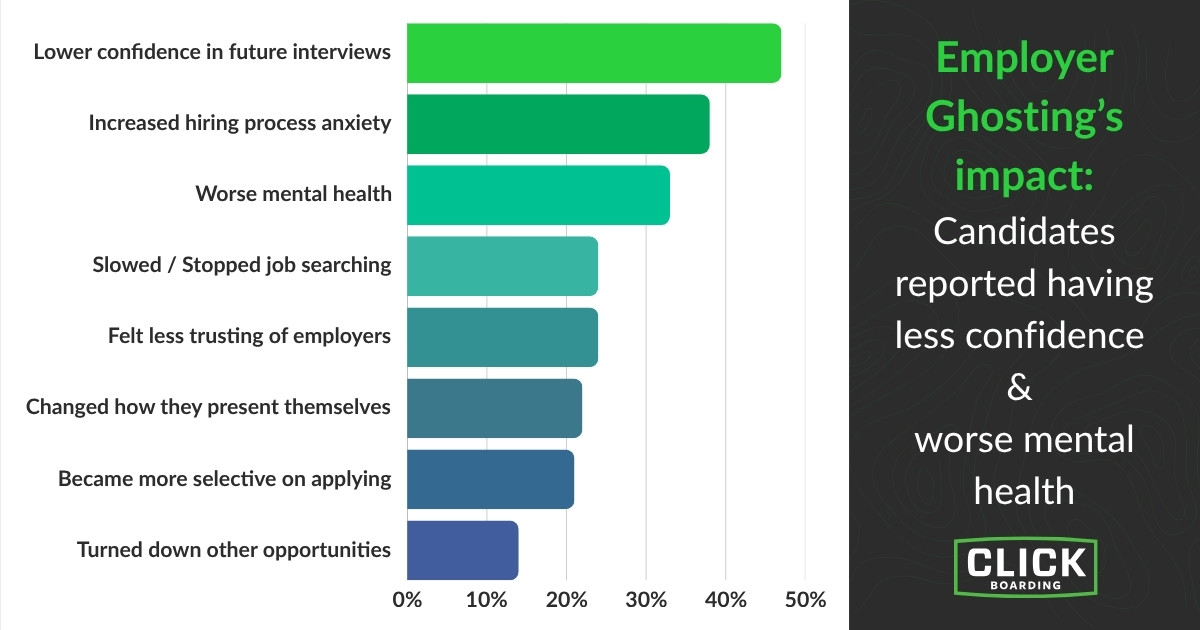
On the other side of things, being ghosted can also have an emotional toll. Researchers found ghosting and coercive control were both linked to increased feelings of paranoia, and 93% of the people who reported employer ghosting in our survey said it impacted them in some way.
This included:
- Feeling less confident in future interviews (47%)
- Feeling more anxious about the hiring process (38%)
- Experiencing a negative effect on their mental health overall (33%)
The majority of people (67%) also think that companies underestimate how much ghosting affects candidates – only 11% disagree, and the rest are unsure.
Being ghosted can feel personal, but it’s often linked to timing or capacity. Ryan Mohr, Click Boarding’s Director of Client Success, says “a company’s communication failure isn’t a measure of self worth” and describes being ghosted by an employer as “a symptom of a broken or under-resourced process, not a reflection of someone’s candidacy”.
If you find yourself ghosted by an employer, Ryan recommends updating your application status, sending one professional follow up and then redirecting your energy. A company that can’t manage basic candidate communication is showing you something real about how they operate.
“I’d encourage candidates to remember that hiring relationships run both ways. The organizations that treat people well throughout the process, even when the answer is no, are the ones candidates return to, refer others to, and advocate for.”
Ryan Mohr, Director of Client Success
How employers are tackling the rise in ghosting
Ghosting has sadly become an expected behavior across both personal and professional lives. In the workplace, this has highlighted the importance of maintaining pre-employment engagement when candidates are most likely to lose momentum or disconnect from the process entirely.
Adam says, “Poor engagement in this window leaves a company more open to ghosting or having a candidate take a competing offer. It also sets a precedent for the rest of the employment as this is the only impression a candidate has about your company and what it’s like to work there.”
Preboarding is being used by organizations to deliver a more structured and engaging experience that keeps new hires informed and connected all the way through to their first day.
Learn more about our preboarding platform and some of the ways employers are trying to prevent ghosting.
Our research process
The data for this article was collected via a 2026 survey of 2,000 adults in the United States who have changed jobs within the past two years.
- Search data was sourced via Google Trends in April 2026.
- Reddit examples are drawn from public posts discussing workplace ghosting and represent unverified, self-reported experiences.