


With a 450% increase in searches for “candidate ghosting” over the last 12 months, in the U.S. alone, the problem of candidates vanishing during the hiring process seems to be growing.
So-called candidate ghosting happens when a new hire or potential employee disappears without warning or communication. Unsurprisingly, it can be costly for organizations and their HR teams in terms of time, money and resources.
To find out the scale of the problem, we asked 2,000 adults in the U.S. who have changed jobs within the past two years about when, how and why they have ghosted a new employer.
This article covers some of our key findings, including the times when your new hire is most likely to ghost and the things you can do as an employer to reduce the risk:
- Key statistics on new hire ghosting
- The critical period when most employees ghost and what it could cost you
- Three things that could be putting off your new employee
- It’s not just a candidate issue; ghosting goes both ways
- Reducing ghosting with a better preboarding experience
Key statistics on new hire ghosting
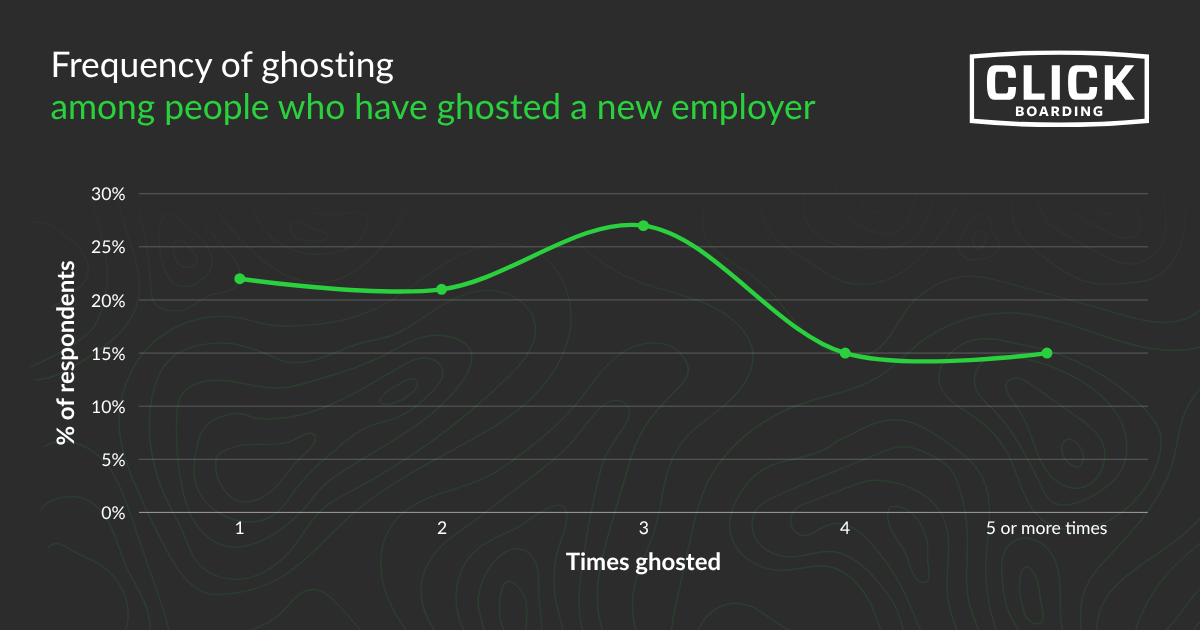
More than half of the people we surveyed admitted to ghosting a new employer (53%), reinforcing how normalized the practice has become. And if that wasn’t high enough, 78% of ghosters have done so more than once, with three times actually being the most common frequency among our respondents.
Just as concerning as the frequency of the issue is how ‘acceptable’ ghosting seems to be becoming in the hiring process, in the eyes of candidates:
- 31% of those who have ghosted a new employer don’t feel any guilt about having done so.
- The same number of people (31%) don’t feel any obligation to tell a new employer that they have changed their mind and won’t be progressing with a role.
- Nearly half of people (49%) think that ghosting has become an accepted part of the hiring process.
“This is a risky attitude because professional relationships tend to come back around in ways people don’t expect. Industries are often much smaller and more connected than they appear.”
Christine Marino, Chief Strategy & Transformation Officer
As for why people are ghosting their new employers, 45% would do so to avoid continuing an uncomfortable situation, while one in three people (34%) would rather ghost someone than have an awkward conversation. Interestingly, very few people (9%) said they would prefer to be ghosted themselves instead of having an awkward conversation.
Demographic influences on ghosting
Ghosting rates are the highest and most frequent within information, technology and scientific job roles, where 63% of people said they had ghosted a new employer.
| Industry | % of workers who have ghosted an employer |
| Information, science & technology | 63% |
| Business & professional services | 60% |
| Transportation & logistics | 57% |
| Creative industries | 56% |
| Health & social care | 54% |
| Hospitality & retail | 52% |
| Public services & security | 41% |
| Education & charity | 40% |
High-turnover sectors like hospitality and retail (52%) and health and social care (54%) are also reporting high levels of workplace ghosting, but the fact that rates are even higher in some industries not usually in the spotlight just shows how widespread the problem has become.
Other differences across demographic groups include:
- 25-34 year olds are most likely to consider ghosting an employer (43%), though 35 to 44 year olds have ghosted the most in the past (56%). Levels are fairly similar across younger age groups.
- Women are more likely to feel obligated to tell a new employer that they have changed their mind and will not be progressing with a role (48% of women versus 37% of men).
- People are most likely to ghost in Missouri (74%) and least likely to in Kansas (33%). People in Missouri and Kentucky have ghosted their new employer the highest number of times (twice on average).
The critical period when most employees ghost – and what it could cost you
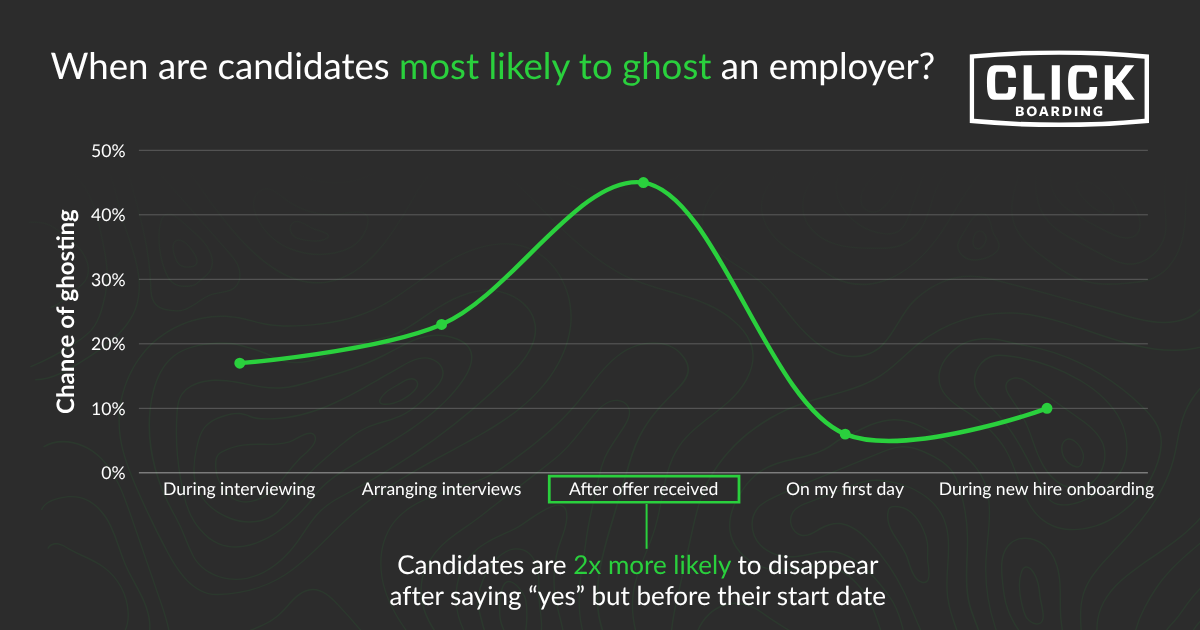
45% of people who ghosted did so in the period between receiving a job offer and their first day, presenting the highest risk and illustrating why this timeframe is so important for employee engagement.
It is a significant window, with 61% of the people we surveyed waiting at least two to three weeks to start their new job and 29% waiting more than a month.
Adam Wachtel, Click Boarding’s Chief Technology Officer, says, “Poor engagement in this window leaves a company more open to ghosting or having a candidate take a competing offer. It also sets a precedent for the rest of the employment as this is the only impression a candidate has about your company and what it’s like to work there.”
If candidates don’t hear from the company during this period, they often begin questioning whether their new employer is organized, excited about them or even prepared for their arrival.
At the same time, candidates are frequently still receiving recruiter outreach and competing opportunities. Without continued engagement, emotional commitment to the role weakens very quickly.
“Ghosting is often less about the individual being irresponsible and more about disengagement occurring before the employment relationship ever truly begins.”
Christine Marino, Chief Strategy & Transformation Officer
The risk significantly drops after a new hire formally starts their role, though it is still present. 15% of people have ghosted an employer during or after their first day, which reinforces the need for engagement to be maintained throughout onboarding.
The cost of being ghosted as an employer
The financial impact of candidate ghosting depends on the stage of the hiring process you are in. It can be felt through:
- Recruitment agency fees or advertising spend which is rarely recoverable once an offer is accepted.
- Internal labor cost of the HR and hiring manager’s time throughout interviewing, screening, coordination and offer management.
- Vacancy costs including revenue loss, overtime expense or delayed delivery while the role remains open.
A company typically spends 75-90% of its full cost-per-hire (CPH) when a candidate ghosts.
The table below illustrates what this looks like across different stages of the hiring process:
| Stage | Est. Sunk Cost | What’s Lost? |
| Application / Screening | 10-15% | Job board spend; Talent Acquisition time |
| Post-interview, Pre-offer | 40-60% | HR + Hiring manager’s time; multiple rounds of interviews |
| Post-offer, pre-start | 75-90% | Nearly full investment from internal teams + agency fees |
| Post-day one | 100% | All onboarding investments |
With 45% of ghosting happening between offer acceptance and a candidate’s first day, a company will typically have spent 75-90% of its full cost-per-hire when a candidate ghosts. SHRM puts the average CPH at $5,475 for non-executive roles, though for roles filled through agencies, that figure climbs significantly higher.
Adam says, “The cost of turnover is very much quantifiable and there is a correlation between high turnover and a disjointed onboarding process. This can be felt even more in industries such as healthcare or retail, which are so revenue-driven.”
You can use our onboarding ROI calculator to get a more accurate estimate for your organization.
Why you need to be engaging employees before day one
Preboarding transforms a candidate from someone who accepted a job into someone who already feels part of the organization, yet many companies still treat preboarding as a checklist of forms and compliance tasks.
In reality, candidates are evaluating the company experience just as much as the employer is evaluating them. Simple actions like a welcome message from a future manager, introducing team members early or explaining what the first week will look like, can dramatically improve engagement and reduce ghosting.
“I wish more organizations would focus on making onboarding feel human instead of purely administrative. Everyone should remember their personal experience from starting a new job and create the experience they wish they had.”
Christine Marino, Chief Strategy & Transformation Officer
Danielle Balow, Click Boarding’s Vice President of Customer Transformation, agrees with the importance of humanization, saying, “If you don’t make somebody feel important and keep them interested, then that’s when you’ll start to see ghosting happen.
“When I started at Click Boarding, a personal phone call and the words ‘we really want you here’ was something that made me choose the company over another employer who I struggled to get a hold of.”
The three phases of preboarding engagement
Engagement in phases is recommended so as not to overwhelm candidates:
- The first phase is immediately after offer acceptance and should focus on reassurance, excitement and next steps.
- The second phase is operational readiness – helping the employee complete onboarding tasks, understand expectations and feel prepared.
- The final phase is human connection before day one. This can include introducing managers, teammates, culture and what the first week at the company will look like.

This is explored more in our article covering preboarding tasks that prevent candidate ghosting.
The cadence itself matters less than consistency and relevance. Even small touchpoints can have a major impact when they feel intentional and personalized. If unsure, too much is better than no communication at all.
Danielle adds, “A lot of employers think that good enough is good enough. It isn’t, and this is when it creates friction for both the employer and potential employees.
“Once companies recognize that, they start looking for a more strategic and orchestrated approach to preboarding, which is where we come in.”
“A lot of employers think that ‘good enough’ is good enough. It isn’t.”
Danielle Balow, Vice President of Customer Transformation
Three things that could be putting off your new employee
The three things most likely to cause a new hire to ghost their employer, according to our survey, are:
- Unprofessional behavior or comments during interviews (reported by 47% of people surveyed)
- Conflicting or misleading information during the hiring process (reported by 39% of people surveyed)
- Feeling unwelcome or not getting on with people they spoke to at the company (reported by 38% of people surveyed)
A “lack of clarity about the role, responsibilities, expectations or job offer” and “poor or slow communication from the employer” were also commonly reported, each identified by 36% of respondents.
This type of behavior can damage trust early on in the process, which is an issue because candidates often make emotional decisions long before the formal start date.
“These findings actually reinforce something we see consistently across the market: candidates are far less likely to ghost when they feel respected.”
Christine Marino, Chief Strategy & Transformation Officer
Organizations that create transparency, consistency and authentic connection throughout the hiring journey generally see stronger onboarding completion and lower drop-off rates.
“If ghosting has become a problem in your workplace, set up an automated survey to find out why a candidate didn’t show up”, Danielle recommends. Common themes could point you towards something in your preboarding or onboarding process that’s going wrong or putting off new employees.
It might not always be something you’ve done, and that’s good to know too. Survey respondents said other circumstances that would make them most likely to ghost a new employer are receiving a better offer elsewhere (37%), changing their mind and wanting to avoid confrontation (24%), or feeling unprepared or unsure about their suitability for the role (20%).
Though, early engagement can still help employees to feel more prepared and less likely to consider alternative offers. As Danielle explains, “If a candidate has two offers on the table and one company is making them jump through hoops versus one that is making it really easy and simple, they’re going to choose the path of least resistance. It’s human nature.”
It’s not just a candidate issue; ghosting goes both ways
Ghosting isn’t exclusive to one side of the hiring process. In fact, slightly more people believe that they have been ghosted (59%) than those who report ghosting a new employer (53%). 45% of respondents also said they have been ghosted by a new employer more than once.
Signing a contract hasn’t proved commitment either: of the people who were ghosted, 36% were ghosted after signing a contract and 14% were ghosted after starting the job.
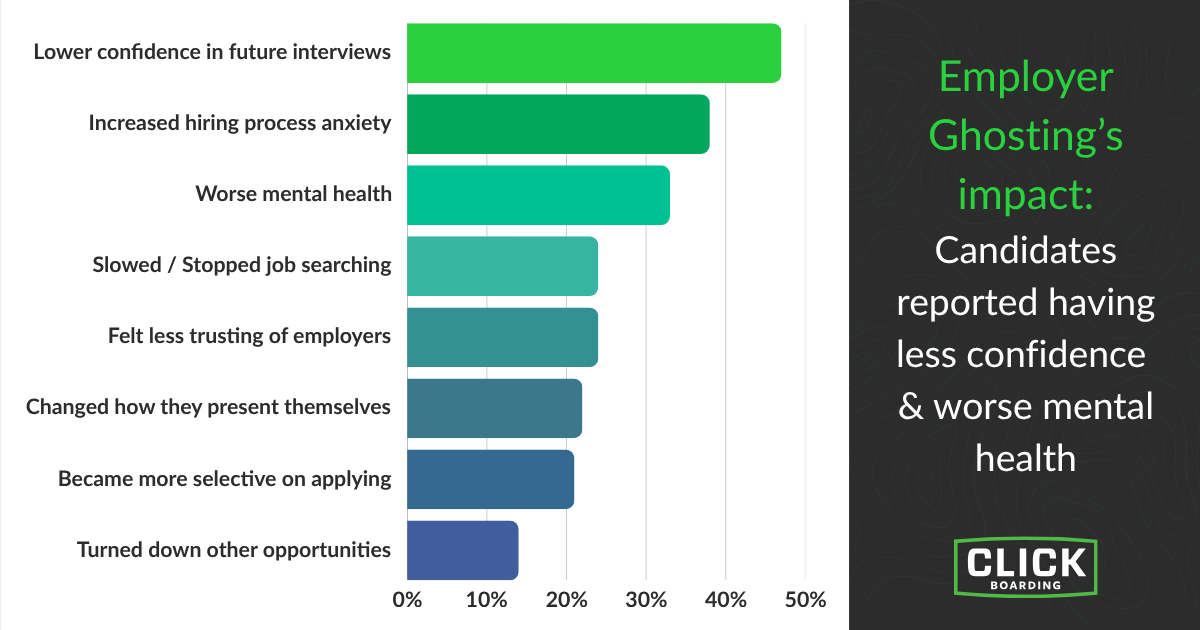
Whether this was a deliberate act by the employer or a miscommunication, it has a lasting effect on those involved. 93% of people who said they were ghosted were impacted in some way, such as:
- Feeling less confident in future interviews (47%)
- Feeling more anxious about the hiring process (38%)
- Experiencing a negative effect on their mental health overall (33%)
Researchers have also found that ghosting and coercive control are both linked to increased feelings of paranoia.
Examples of employer ghosting
More people are turning to Reddit for ghosting-related advice each year, including a 250% rise in searches for “Reddit ghosting” in the US over the last five years. We’ve rounded up a few of the employer ghosting experiences people are sharing online:
- One person was verbally offered a role and asked to be patient while final details were confirmed. They waited a week and a half with no further updates and felt they had been ghosted by their point of contact who then stopped replying completely.
- Another Reddit user was hired by a restaurant chain, attended training sessions and completed onboarding paperwork but then never received the work schedule they were promised or any further communication from the employer.
- Somebody else shared how they progressed through multiple interview stages with the employer suggesting they would be hired pending an in-person meeting. But then all communication stopped and their emails and calls went unanswered.
Candidates should never wonder what is happening next in the hiring process and communication should be clear and timely.
Adam says, “On places like Reddit where you’ve got moderated but anonymous content, people will explicitly call out organizations that treated them poorly. For example, ‘I will never work for X company because here’s how they treated me during the onboarding process’.
“Word gets around quickly, and people do their research before taking jobs. If you’re ghosting candidates, expect this to come back around and influence people who might have been interested in working for you.”

Maintaining positive relationships
While a candidate may not be suitable for a current vacancy, that doesn’t mean they won’t be valuable in the future. But if you’ve already burnt bridges, that candidate is likely to avoid any subsequent roles that are advertised.
One in five people we surveyed (21%) have been contacted by an employer who previously ghosted them. Most people said this would make them feel:
- Confused and skeptical about intentions (42%)
- Curious about why they reached out (33%)
- Angry or annoyed (30%)
Only 22% would be willing to hear the employer out and the majority (56%) wouldn’t consider working for an employer who previously ghosted them.
Danielle notes, “Even a really great automated response can help retain your relationship. And not just saying ‘thanks for your application’, but something that clearly explains the next steps in the process and what it means if they don’t respond.”
Reducing ghosting with a better preboarding experience
The highest risk of ghosting is before day one. It is often the result of candidates feeling disconnected or disengaged, which is why consistent and relevant pre-employment communication and active engagement are so important.
We’ve helped organizations achieve an average 42% reduction in new hire ghosting by creating a more connected and streamlined preboarding experience.
Click Boarding’s employee preboarding platform helps build excitement and buy-in with automated reminders, real-time updates and simple workflows that walk new hires through forms, signups and notices, all with a mobile-first experience that goes where they are.
Learn more about our preboarding platform or explore some of our other resources, such as the best strategies for a positive preboarding experience and the key differences between preboarding and onboarding.
Our research process
- This article is based on findings from a 2026 Click Boarding survey of 2,000 U.S. adults who changed jobs within the past two years, conducted via OnePoll.
- Search data was sourced via Google Trends in April 2026.
- Reddit examples are drawn from public posts discussing ghosting in the workplace and represent unverified, self-reported experiences.