


Your new hire may still be waiting to start work, but their employee experience starts the moment they sign their offer letter.
While this in-between period can be exciting (“I have a new job!”), it also brings nerves and uncertainty (“did I make a good choice? Can I do this?”). Employers can – and should! – use this time to build engagement, offer reassurance, and provide much-needed clarity about what comes next.
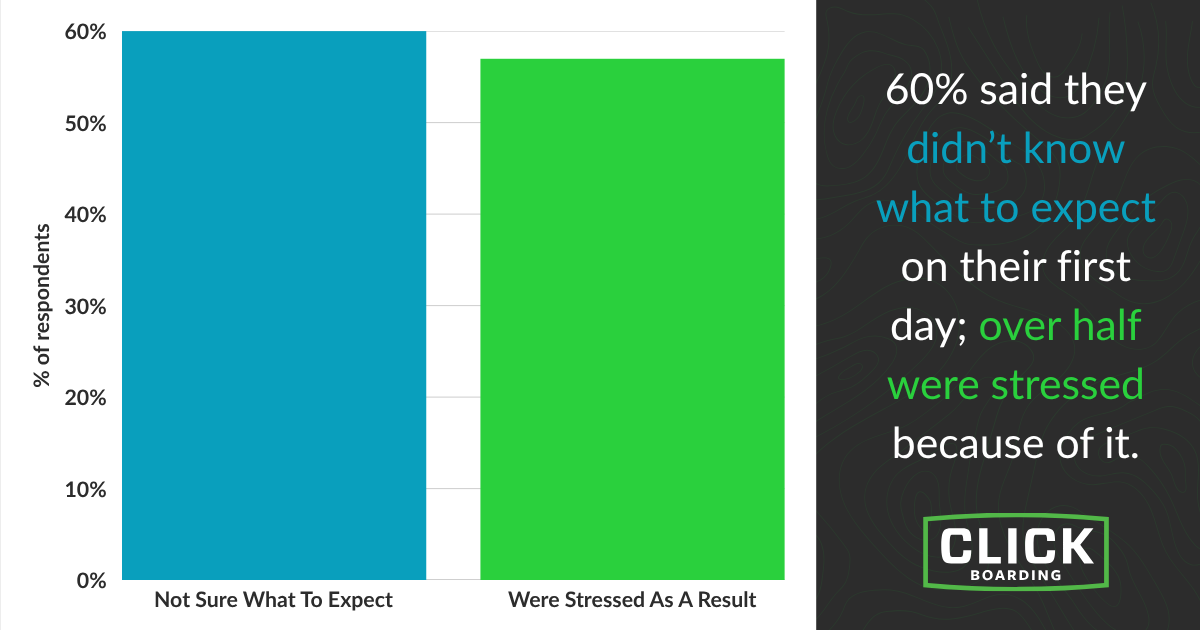
Yet this isn’t always happening; our survey of 2,000 U.S. adults who changed jobs in the past two years found that 60% were unsure what to expect on their first day. As a result, nearly as many (57%) said this left them feeling anxious or stressed.
These early interactions matter more than employers may realize. For 53% of respondents, the experience between accepting an offer and starting the role affected their commitment to their new employer, showing that uncertainty created before day one has a lasting impact.
Alongside our findings, Chief Strategy and Transformation Officer Christine Marino and Chief Technology Officer Adam Wachtel share their perspectives on what employers can do to support new hires before day one.
Click to jump to a section:
- The moment employers can engage or disengage new hires
- What candidates want before day one versus what they receive
- Why the weeks before a new job can feel so stressful
- Red and green flags that shape first impressions
- Gen Z’s more likely to need early support, despite caring less about a warm welcome
- Why preboarding is a must-have for early engagement
- Preboarding Q&A
The moment employers can engage or disengage new hires
The challenge begins as soon as an offer of employment has been accepted. Without a clear next step or consistent contact, new hires can find themselves in what we call The Valley of Uncertainty™. At this point, they are no longer candidates, but may not yet feel part of the organization they are about to join.
This window can be a long period … almost a third of survey respondents report having a gap of two to three weeks (32%), while 29% are left waiting for a month or more.
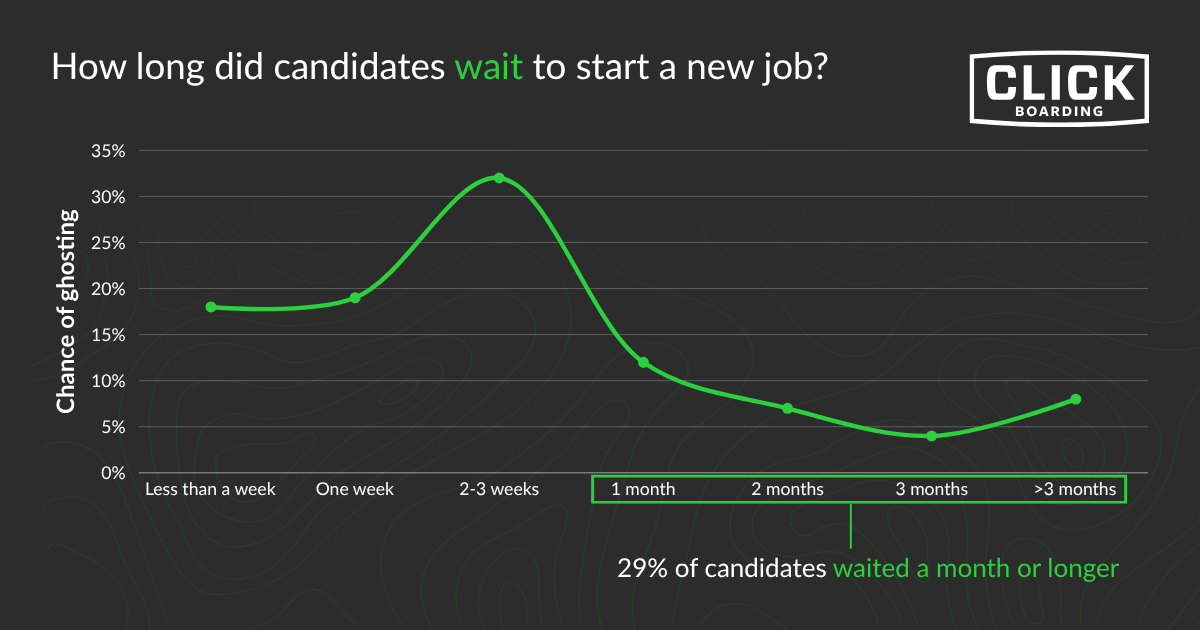
Currently, many employers are not using this time efficiently to connect with new team members. 31% of respondents said they did not receive regular communication and engagement during this period. Additionally:
- One in ten (10%) were not contacted by their new employer at all
- Nearly a quarter (24%) were contacted once per month or less
This matters in a labor market where more people are willing to make a move. Industry research found that 79% of people were more likely to accept a new job than they were a year earlier, while 66% had changed or considered changing career fields in the past year.
New hires do see the benefits of pre-employment engagement, which we call preboarding. More than half (53%) said that improved communication would have made their recent transition much smoother, while 61% felt the same about having clearer expectations.
Preboarding refers to everything an employer does before a new team member’s first day to help engage, connect and prepare them for their new role. Some examples include sharing paperwork, introducing them to their new team, and scheduling regular check-ins.
“Preboarding should begin as soon as an offer is accepted. Consistent, meaningful communication during this period can reduce the likelihood of candidate drop-off by helping new hires build an emotional connection with the organization before they even walk through the door.”
“It also gives them clearer expectations for their first weeks, helping them arrive more engaged, confident and ready to contribute.”
Christine Marino, Chief Strategy & Transformation Officer
26% also stated that a clear and structured onboarding plan would have made them feel more positive about their new employer.
The risk of losing new hires before their start date

Disengagement can be costly and even impact employee retention. Two in five survey respondents (39%) say slow and unresponsive communication from an employer would make them most likely to reconsider accepting a job offer. A quarter (26%) state not receiving a clear or organized onboarding plan would have the same effect.
Adam Wachtel, Click Boarding’s Chief Technology Officer, says, “Poor engagement between a job offer and an employee’s first day leaves a company more open to ghosting or having a candidate take a competing offer.”
At this stage, a company has likely already invested 75-90% of its full cost-per-hire (CPH). Our recent research into employee ghosting found that 45% of people who had ghosted an employer did so during this window.
Read more about the ROI of employee preboarding.
What candidates want before day one versus what they receive
Almost all respondents from our survey (95%) identified at least one preboarding activity they would find helpful. But the activities that new hires are currently experiencing do not always match the support they would value the most:
Contrast this with what new hires want:
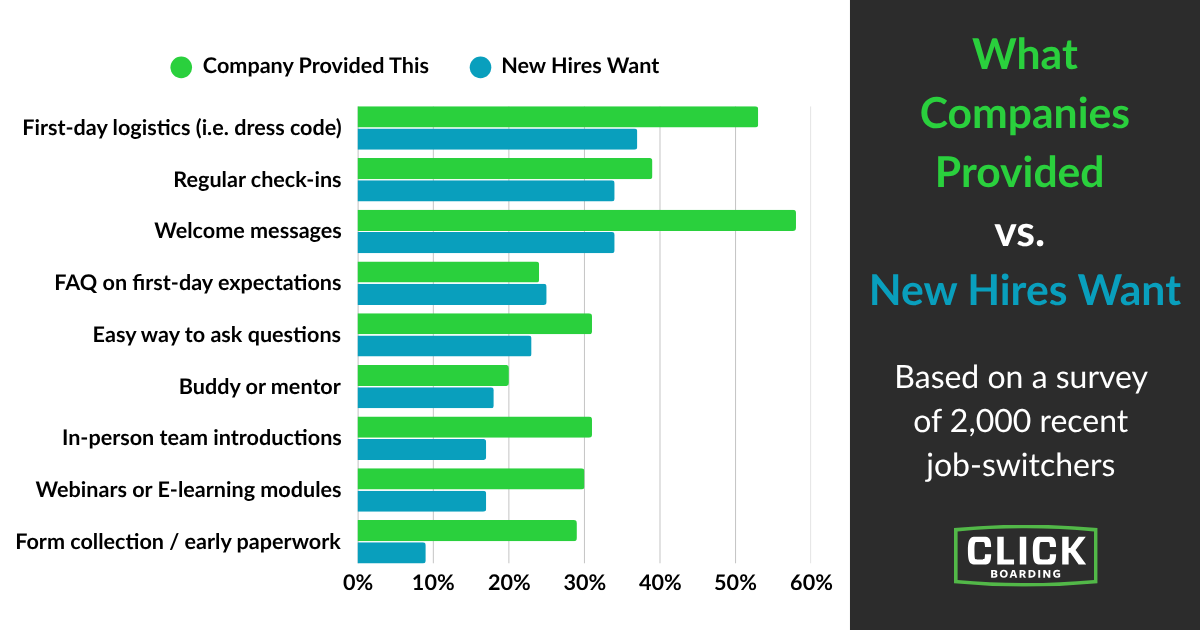
Respondents were allowed to select all activities they experienced in their recent job change, and then up to three activities they would have found most helpful.
While sending over laptops and benefit enrollment forms early could be a lower priority, clarity and reassurance can’t wait. New hires rated welcome emails, regular check-ins and basic first-day logistics far more highly than early equipment or paperwork provisions.
Each was selected by around five times as many respondents as early equipment, and nearly four times as many as early paperwork; this shows people value clear communication above tools they cannot yet use.
Christine says, “I’d actually err on the side of over-communicating rather than not doing enough. A steady stream of information and excitement every few days is much better than leaving someone wondering where they stand and when they’ll next hear from you.”
It’s equally as important to consider the contents of the communication as much as it is the frequency. At the top of these lists, welcome emails or messages are the most commonly received preboarding activity, but basic first-day logistics is the support respondents found most helpful.
A good way to provide key information is through an FAQ or ‘what to expect on your first day’ guide. This was the fourth most-wanted preboarding activity among respondents, but was the eighth most-likely to be provided.
“A good first-day FAQ guide doesn’t need to be complicated; it just needs to answer the questions new hires are most likely to have, let them know who they are going to meet and provide a simple outline of what to expect.”
Christine Marino, Chief Strategy & Transformation Officer
Useful information includes:
- First-day start time and location
- Key login details for remote workers
- What to bring
- Company dress code
- Parking or travel guidance.
Why the weeks before a new job can feel so stressful
Transitioning jobs already has an impact on people’s well-being – our survey found that 85% of people feel stress when changing jobs and 94% experience anxiety. Another study found that 87% of job seekers have ‘new job jitters’ while 53% of workers say it’s scarier than a trip to the dentist, holding a spider or snake, or even skydiving.
Our findings suggest the greatest source of anxiety is the new-job experience rather than the process of leaving a previous role, implying that new employers have a greater opportunity to reduce the uncertainty a new hire is experiencing. The most common reasons for feeling anxious are:
- First day at the new job: 45%
- While interviewing for jobs: 40%
- The nerves of waiting to start a new role: 34%
People are more than twice as likely to experience anxiety when starting a new job than the nerves of telling their old boss they quit. 45% said their first day at a new job was among the most anxiety-inducing stages, compared with 21% who said it was handing in notice to their previous employer.
Survey respondents also report higher stress levels when starting a new role. When asked which stage they found more stressful, 38% selected starting a new role, compared with 15% who selected leaving their old role. A further 32% found both equally stressful.
More than three-quarters of people who say stress interferes with their work say it carries over to their personal life, particularly men (83% versus 72% for women).
How to help new hires feel more confident
“A new job can be exciting, but it can also be mentally demanding. People are often leaving behind familiar routines, relationships and ways of working, all while preparing to prove themselves in an entirely new environment.
“Left unsupported, these feelings can affect confidence and mental health before an employee has even had the chance to settle in.”
Christine Marino, Chief Technology Officer
Preboarding gives employers a practical point at which to provide early well-being support. Clear communication, realistic expectations, opportunities for connection and timely answers to questions can all help reduce the mental load associated with the transition.
95% of new hires say that regular updates and activities (preboarding) from their new employer would improve their confidence in some way before starting a new role. The most commonly reported benefits were:
- Feeling more welcomed and engaged with the team: 32%
- Feeling confident about my role and responsibilities: 30%
- Better understanding of what to expect on the first day: 29%
- Reducing nerves and anxiety: 29%
- Feeling less stressed about starting: 26%
The aim is not to eliminate the natural nerves faced when starting a new role, but to prevent uncertainty from becoming unnecessary stress, self-doubt or disconnect.
When people feel supported before they start, they are better placed to begin their new role in a positive and healthy frame of mind.
Red and green flags that shape first impressions
Aligning with the rest of the survey findings, first impressions are largely shaped by how employers communicate and how welcoming they are. The top green flag reported by new hires is a friendly and welcoming experience (32%), closely followed by transparency around pay and role expectations, a clear onboarding plan (both 26%) and fast and responsive communication (25%).
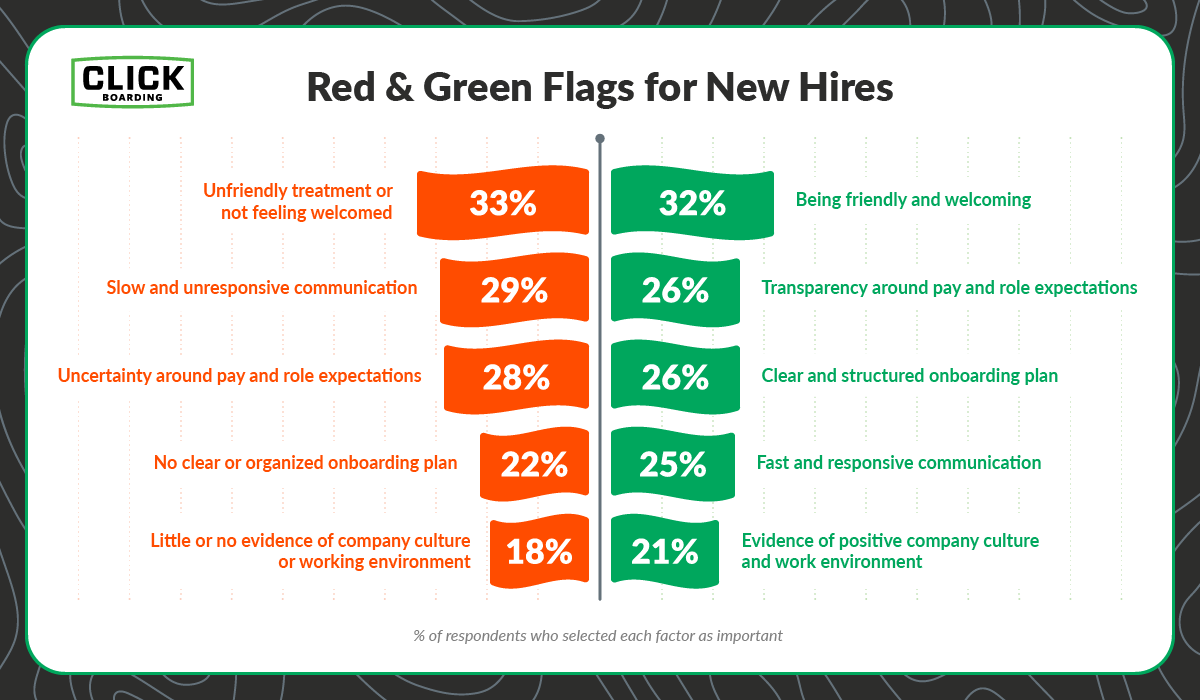
The same factors quickly became red flags when absent, with 33% citing unfriendly treatment, 29% slow or unresponsive communication and 28% uncertainty around pay or expectations.
When asked what could make them reconsider after accepting an offer, respondents pointed to many of the same red flags:
- Unfriendly treatment or not feeling welcomed: 46%
- Slow and unresponsive communication: 39%
- Uncertainty around pay and role expectations: 33%
- No clear or organized onboarding plan: 26%
- No flexibility in the interview process: 18%
Interview flexibility stands out as a new concern while company culture becomes less influential, falling to eighth place at 12%.
“Candidates do not stop forming opinions when they accept an offer. Uncertainty around the role and a lack of onboarding structure can give people reason to question their decision, while a clear plan for joining is a strong positive signal.
“Good preboarding and onboarding maintain the trust built during recruitment by keeping people informed, answering questions and following through on the experience they were promised.”
Christine Marino, Chief Strategy & Transformation Officer
The findings also suggest feeling welcomed is about more than material gestures.
Welcome gifts and branded merchandise had only 13% say receiving them would make them feel positive, while just 7% would be concerned about not receiving them. Though people want to feel welcomed, they want real value … not stuff.
The power of connection
The value new hires place in welcoming behavior is clear, and though sending a welcome message is a good starting point, it is not necessarily enough to help them feel connected. While 58% of survey respondents report receiving a welcome message, more than half still didn’t know who they would be working with before their start date (52%), and a similar amount (54%) felt stressed because of this.
Before their first day, twice as many people also desire in-person connection as opposed to a virtual one. Our survey shows that 18% would find a buddy or mentor most helpful, and 17% say the same for in-person team introductions. This compares to just 8% who would prefer virtual team introductions.
This matters because unfriendly treatment or not feeling welcomed are both the leading red flag and the factor most likely to make candidates reconsider an accepted offer. It’s also a greater concern for women (37%) than men (27%).
Gen Z’s more likely to need early support, despite caring less about a warm welcome
While an employer being friendly and welcoming matters across all age groups, it generally carries more weight for older workers. 30% of 18–24-year-olds identified it as a green flag, compared with 44% of respondents aged 45+. Similarly, 33% of younger respondents cited not feeling welcomed as a red flag, compared with 43% of older respondents.

On the other hand, Gen Z appears to care more about regular and consistent communication over how friendly an employer appears to be.
Almost twice as many 18–24-year-olds as workers aged 45+ said regular updates and preboarding activities would make them less likely to back out after accepting an offer (19% versus 10%), and they are more than twice as likely to back out following a lack of flexibility in the interview process (20% versus 9%).
This desire for clarity and reassurance is understandable as Gen Z reports higher levels of anxiety while waiting to start their new role. Two in five 18-24-year-olds (39%) said waiting to start was the period they felt most anxious, compared to 29% of those over the age of 45.
Similarly, older age groups are the most emotionally resilient when it comes to having no contact from employers. Over half (51%) of people 45+ say not hearing from their employer didn’t make them feel anxious, compared to 29% of the younger generation.
Employers should see these differences as a reason to build flexibility into preboarding, not as a reason to create entirely separate approaches.
“Preboarding does not need a different process for every generation, but it should avoid assuming that one form of communication works for everyone.
“Some age groups place higher value on warmer, personal gestures, such as a thank-you note or early team introduction, while others will benefit most from frequent contact and reassurance that they have not been forgotten. A good preboarding plan should give employees a balance of both!”
Adam Wachtel, Chief Technology Officer
Why preboarding is a must-have for early engagement
Effective preboarding can strengthen engagement while addressing several of the new hire needs we’ve identified, such as connection, clarity, and reassurance.
This early engagement reduces the chance of ghosting, which is a high cost for employers. Ellis Medicine had a new hire ghosting rate of 53% before implementing a structured preboarding and onboarding process. This led to 99% of those who accepted a job filling their role as expected, saving the company upwards of $800,000 per year. Our research found that a majority of those in the health and social care industry face uncertainty before their start date, but need not have to.
Another of our clients in the insurance industry experienced savings of $470,000 through automated preboarding activities such as:
- Pre-day one paperwork like background checks and I-9 verifications
- Building team alignment for a better first-day experience
- Automating IT requests to IT to avoid last-minute access issues for new hires
Onboarding was also 32% faster thanks to a robust preboarding process that sped up paperwork and verification.
Take a look at our employee preboarding checklist to learn more about exactly how and when to plan key touchpoints throughout a new hire’s transition period.
“It’s hard to feel engaged with a new workplace when you are still waiting to find out the basics. Preboarding means that a new hire gets to know the team, has a better idea of what is coming and is more likely to begin the role already feeling involved.”
Adam Wachtel, Chief Technology Officer
Preboarding Q&A
Analyzing search data shows us where some knowledge gaps remain around employee preboarding in the U.S., and basics are what people would most like clarity on.
The Q&A below answers some of the most commonly asked questions from people searching for ‘employee preboarding’.
Preboarding is essentially everything that happens between someone accepting a job offer and their first day at work. During that gap, a good employer stays in touch in helpful ways such as sharing team information, making it easy to handle paperwork and helping new hires feel confident about the decision they made to join the company.
Done well, preboarding turns the wait before day one into the start of the employee experience, showing new hires they are valued, easing those natural nerves, and helping them arrive prepared.
We call this preboarding, and it’s the entire amount of time between the moment a candidate accepts an offer through to their first day.
It could be a few days or several weeks, depending on notice periods and hiring timelines, but the key thing to remember is that this should span the entire time… one simple welcome email won’t cut it.
Preboarding happens before someone’s first day and includes things like completing compliance paperwork and getting introduced to your team virtually. The difference with onboarding is that it begins once an employee has started working and continues through their first several weeks or months.
This might involve in-person (or virtual) orientation, role-specific training, building team relationships, and settling into day-to-day responsibilities.
How Click Boarding helps build a better preboarding experience
Click Boarding helps HR teams automate preboarding and onboarding activities, with structured workflows for communications, compliance tasks and first-day preparation.
With 60% of new hires still unsure what to expect on day one, there is a clear opportunity to replace last-minute uncertainty with a more considered introduction to your company.
Explore our preboarding and onboarding platforms to see how we can help you improve new hire engagement, reduce ghosting rates, and shorten time to productivity.
Our research process
This article is based on findings from a 2026 Click Boarding survey of 2,000 U.S. adults who changed jobs within the past two years, conducted via OnePoll.
Search data was gathered using AlsoAsked and includes some of the most-searched questions in relation to ‘employee preboarding’ within the U.S.