

For those hiring in healthcare, it’s tougher than ever.
Some of our recent research found healthcare as a medium-risk industry to be ghosted (where a potential candidate no-shows for their first day), while additional research finds that early engagement is hugely important to building trust.
The payback? First-year retention: up to 29.5% per the Nursing Solutions Institute … and it makes you a more attractive employer in an already-crowded market.
Here’s a more full picture of the healthcare sector – click to jump to a section:
- A competitive hiring landscape
- Uncertainty before their start date
- Healthcare preboarding engagement statistics
- Healthcare ghosting statistics
A competitive hiring landscape
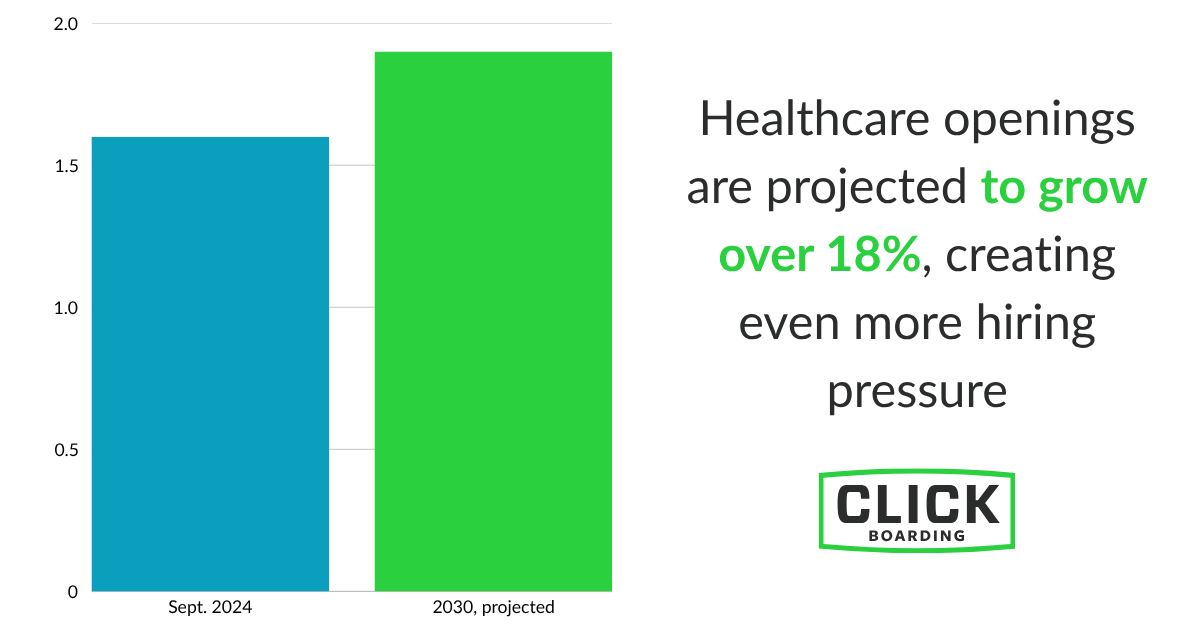
Healthcare hiring isn’t slowing down anytime soon. Healthcare occupations are projected to have around 1.9 million job openings each year on average between 2025 and 2035, according to the Bureau of Labor Statistics (BLS) … and private healthcare and social assistance is also projected to grow by 9.5% between 2025 and 2035.
That’s the second-fastest growth rate of any industry tracked by the Bureau of Labor Statistics (BLS)!
High volume + rapid growth means healthcare employers aren’t just competing with each other for talent, but also against a labor market that’s structurally short on supply. Longer time-to-fill for openings and higher candidate leverage should be expected.
A few converging factors are tightening the available talent pool for healthcare employers specifically:
- Demand consistently outpaces supply. With close to 1.9 million openings a year, healthcare hiring volume alone creates sustained competition for qualified candidates across nearly every role type … this goes for both clinical and non-clinical.
- Growth is accelerating. A 9.5% growth rate over the next decade means the competitive pressure healthcare employers feel today is likely to intensify as the industry continues expanding faster than nearly every other sector.
- Candidates become more selective. In a market this tight, healthcare candidates can afford to be selective about compensation and increasingly about the hiring experience itself.
A slow, disorganized, or unclear process now a reason to walk away for another offer, and these first impressions matter more tha never.
And so it’s the environment where early engagement (starting from the moment an offer is accepted) becomes a competitive advantage.
Uncertainty before their start date
Uncertainty begins before your new hires do, and it’s lengthier than you might realize; in our survey research, 35% of healthcare respondents said they waited two to three weeks between accepting an offer and starting their role, while another 31% waited a full month or more.
This is a meaningful window in which very little communication tends to happen: 28% said they didn’t receive regular communication from their new employer during that gap at all.
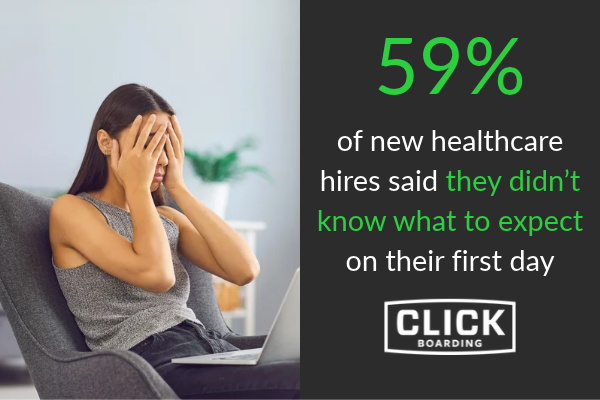
And it’s impactful! 59% said they were unsure what to expect on their first day, and 58% said that uncertainty left them feeling anxious or stressed. And perhaps most tellingly, 49% of healthcare respondents said the experience between accepting their offer and starting affected their commitment to their new employer.
In other words, nearly half of new healthcare hires are forming judgments about whether they made the right choice before they’ve done a single day of work based on how they were treated.
Yet 53% did not know who they would be working with before day one, and most felt stressed because of it; starting their new role was 2x more stressful than leaving their previous one – the first day was the most common source of anxiety (45%), followed by interviewing (40%) and waiting to start (37%). Having someone start feeling anxious and uncertain is the exact opposite of the mindset you want a new hire to have in when the stakes are already high to keep good talent!
Which puts a premium on employee preboarding.
Healthcare preboarding engagement statistics
The good news? In healthcare, candidates aren’t asking for anything elaborate … it’s far more about clarity and consistency. 96% of respondents identified at least one preboarding activity they would find helpful, which suggests the appetite for a better experience is close to universal.
When asked what would have made their own transition smoother, respondents pointed to a few clear themes:
- 62% said clearer expectations would have made their transition smoother
- 56% said better communication
- 27% said a clear and structured onboarding plan would have made them feel more positive about their new employer
Healthcare ghosting statistics
Ghosting (when a candidate disappears) are close to a coin flip.
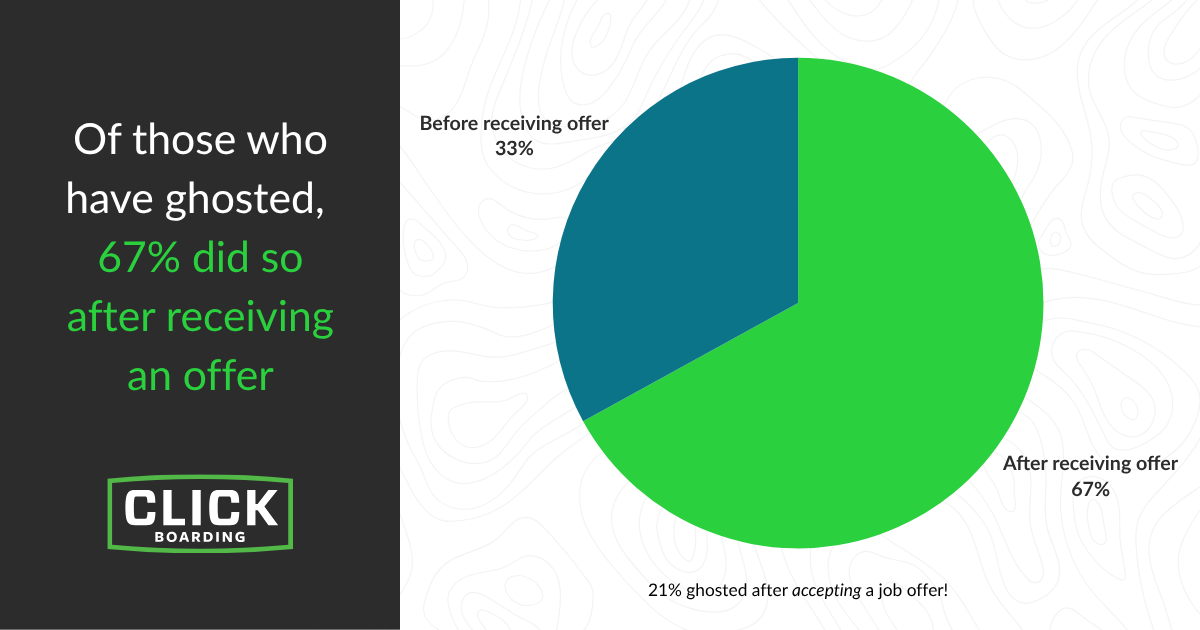
54% of healthcare respondents said they have ghosted a new employer at some point, and 67% of those did so after receiving a formal job offer (with 21% doing so after accepting the offer), when stakes are highest for everyone.
It’s also not typically a one-time lapse: 76% of people who’ve ghosted an employer have done it more than once, with three times being the most commonly reported frequency. Nearly half of job seekers think it’s normal, too (45%)!
What makes healthcare workers reconsider an offer?
There’s three primary tells:
- 44% said unfriendly treatment or not feeling welcomed would make them reconsider a job offer
- 41% said slow and unresponsive communication
- 32% said uncertainty around pay and role expectations
Notice that two of the three top factors are entirely about experience and communication, not compensation! Healthcare candidates are walking away because their hiring and preboarding experience makes them question whether they’ve made the right decision.
The cost of that walking-away is significant, and it compounds in an industry already this short-staffed. As Adam Wachtel, CTO at Click Boarding, put it: “The cost of this turnover is very much quantifiable, and it can be felt even more in healthcare, which is so revenue-driven.”
Creating a better start for healthcare hires: Click Boarding
Built to automate every employee transition, starting with preboarding and onboarding, including support with all those new hire verifications and checks, and then helping you stay on top of every exit, promotion, team change, and M&A.
You get one platform that’s easy to use and built for HR teams to spend less time on manual processes or chasing people down – so you’re spending more time building the business. Ellis Medicine saved $800K+ by fixing their ghosting problem, and you could see similar results, too; explore our healthcare onboarding page for more!
Research note: Healthcare research was completed in conjunction with OnePoll, surveying 2,000 recent job-switchers on their experiences.