


Candidate ghosting after offer acceptance is no longer an anomaly. Across industries, employers are seeing an increase in candidates who accept a role and then disengage entirely before day one. The result is lost time, wasted recruitment spend, and open roles that must be filled again.
This risk is most acute during the notice period. Once an offer is accepted, organizations often reduce communication, assuming the hire is secure. In reality, this is when candidates are most likely to reconsider, receive counteroffers, or lose confidence due to silence or uncertainty.
Preboarding exists to stabilize the hire. While onboarding focuses on long-term engagement and productivity, preboarding is about securing commitment and preventing no-shows. When managed intentionally, it significantly reduces candidate ghosting and protects recruitment investment.
Jump to a section:
Your ghost-proofing checklist: From offer to day one
Preventing candidate ghosting requires consistent, well-timed engagement across the entire preboarding window. The most effective approach is a structured timeline of touchpoints that eliminates silence and reinforces the candidate’s decision to join.
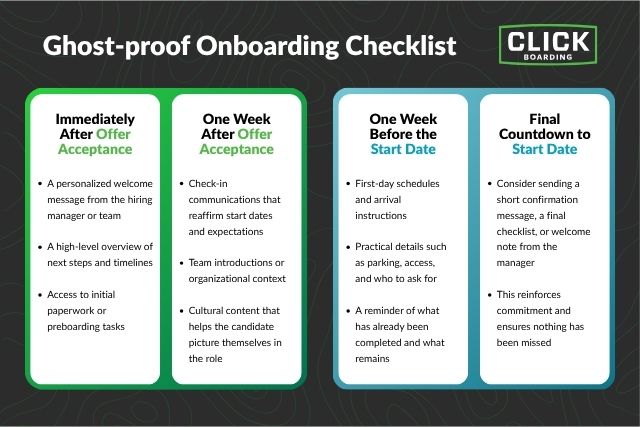 Below is a practical checklist organized by key moments between offer acceptance and the first day.
Immediately after offer acceptance
Speed matters. The first 24 to 48 hours after acceptance set the tone for the entire preboarding experience.
At this stage, candidates should receive clear confirmation that the organization is ready for them. This includes:
- A personalized welcome message from the hiring manager or team
- A high-level overview of next steps and timelines
- Access to initial paperwork or preboarding tasks
Delays at this stage can introduce doubt. Prompt communication signals professionalism, organization, and genuine interest in the hire.
One week after offer acceptance
Once the initial excitement fades, silence becomes the biggest risk factor. This is where many organizations unintentionally allow disengagement to develop.
Effective preboarding employees at this stage includes:
- Check-in communications that reaffirm start dates and expectations
- Team introductions or organizational context
- Cultural content that helps the candidate picture themselves in the role
The goal is not to overwhelm, but to maintain momentum. Consistent engagement reassures candidates that they are still a priority.
One week before the start date
As day one approaches, anxiety often replaces excitement. Candidates may begin to worry about logistics, expectations, or whether they made the right decision.
This is the time to remove friction by sharing:
- First-day schedules and arrival instructions
- Practical details such as parking, access, and who to ask for
- A reminder of what has already been completed and what remains
Clarity reduces uncertainty. When candidates know exactly what to expect, they are far less likely to disengage or reconsider.
The final countdown
In the final days before the candidate starts, preboarding should focus on confidence and readiness.
To reinforce commitment and ensure nothing has been missed, consider sending;
- A short confirmation message,
- A final checklist, or welcome note from the manager. reinforces commitment and ensures nothing has been missed.
At this point, the objective is simple: eliminate any remaining barriers that could lead to a no-show on day one.
Automating engagement to scale your preboarding
While this checklist is effective, executing it manually becomes difficult at scale. High-volume hiring, distributed teams, and multiple stakeholders increase the risk of missed touchpoints and inconsistent experiences.
This is where automation becomes critical. Tools that reduce candidate ghosting ensure that every hire receives timely communication, regardless of workload or hiring volume. Automated workflows can:
- Trigger personalized messages at key milestones
- Track task completion and follow up automatically
- Ensure compliance and paperwork are completed before day one
By removing administrative pressure, teams can focus on meaningful engagement instead of manual coordination.
Click Boarding supports this approach by automating preboarding tasks and communications, creating a consistent safety net that prevents high-value talent from slipping away.
What to do when a candidate ghosts you
Even with strong preboarding processes, ghosting can still occur. When it does, organizations should respond quickly and professionally.
Best practices include:
- Attempting multiple contact methods before closing the loop
- Documenting the disengagement to identify patterns
- Reviewing preboarding timelines to identify gaps or delays
Repeated ghosting is often a signal of process issues rather than candidate behavior alone.
Secure your talent before they start
Candidate ghosting is not an inevitable outcome of today’s hiring market. It is often the result of unmanaged silence during the notice period.
A structured preboarding process, supported by automation, helps organizations avoid candidate ghosting, protect recruitment investment, and ensure new hires arrive confident and ready on day one.
Explore how Click Boarding helps large organizations preboard new employees effectively – better than HRIS modules allow – and reduce candidate ghosting after offer acceptance, request a demo or learn more about its preboarding solutions.