


Employee experience – and everything from retention to engagement – does not begin on day one. Yet many organizations still treat preboarding and onboarding as a single phase, often folding all activity into the first week of employment. That approach creates gaps in engagement, ownership, and alignment between Talent Acquisition and HR.
Understanding the difference between preboarding and onboarding, and where each phase has the greatest impact, helps organizations improve offer acceptance rates, reduce time to productivity, and create a more consistent new hire experience across the employee lifecycle.
This article breaks down where preboarding ends, where onboarding begins, and why treating them as distinct-but-connected phases leads to stronger outcomes for both employees and employers.
Click to jump to a section: Differences | Benefits | FAQs
Difference between preboarding and onboarding
Preboarding and onboarding serve different purposes within the new hire timeline:.
- Preboarding begins after a candidate accepts an offer and continues until their first day.
Its primary focus is reassurance, connection, and preparation. This is the period where candidates decide whether they truly made the right choice. Clear communication, early engagement, and transparent expectations play a critical role here.
- Onboarding starts once the employee joins the organization.
This phase focuses on integration, productivity, and long-term engagement. It includes role-based training, cultural alignment, and helping new hires understand how their work connects to broader business goals.
While these phases may overlap operationally, their goals are distinct. Preboarding is about commitment and confidence. Onboarding is about contribution and performance.
The risks of neglecting preboarding and onboarding
When preboarding is overlooked, organizations risk candidate drop-off, delayed start dates, and lower offer acceptance rates. When onboarding is rushed or treated as an administrative checklist, new hires may struggle to reach productivity or disengage early.
Without clearly defined processes for both phases, teams often experience:
- Inconsistent handoffs between Talent Acquisition and HR
- New hires arriving unprepared or uncertain on day one
- Longer ramp-up times and early attrition
Defining each phase clearly helps prevent these issues and creates a smoother employee experience from the start.
Business Benefits
There’s multiple proven impacts with real bottom-line implications. If you’re curious, you can find out some with our ROI calculator which covers both onboarding and offboarding.
Improving offer acceptance rates through better preboarding
Preboarding plays a direct role in improving offer acceptance rates. Once a candidate accepts an offer, silence or disjointed communication quickly leads to doubt, including a rising trend of deciding to never show up on the first day (“ghosting”).
Structured preboarding keeps momentum going and reinforces your brand during a critical decision window for candidates – one that has significant costs associated, up to 3x the salary per SHRM.
Effective preboarding includes:
- Branded, timely communication that confirms next steps
- Early access to company information and expectations
- Opportunities to connect with managers or teams before day one
These touchpoints reassure candidates they’ve made the right choice by showing clarity, organization, and investment in their success – the opposite of the Valley of Uncertainty that naturally occurs in this time.
As a result, candidates become likely to disengage or reconsider their decision before their start date.
Reducing time to productivity with effective onboarding
Onboarding is where productivity is built. A well-designed onboarding experience helps employees understand their role, priorities, and performance expectations faster; the opposite makes a new hire twice as likely to leave.
Technology-led onboarding supports this by delivering:
- Role-specific training and workflows
- Automated task completion and documentation
- Early exposure to tools, systems, and processes
When onboarding is structured and personalized, employees spend less time navigating uncertainty and more time contributing meaningfully. This reduces time to productivity and creates a more confident, capable workforce.
Bonus: HR teams spend less time handling manual tasks that enable these benefits, freeing them up to handle higher-impact activities.
Understanding the new hire timeline
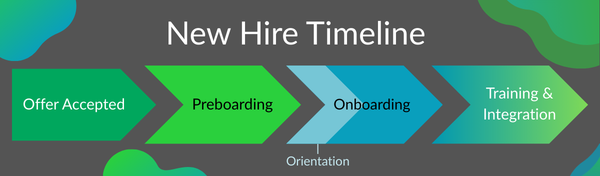
The new hire timeline typically moves through recruitment, preboarding, onboarding, and ongoing development. Each stage has clear start and end points, as well as moments of overlap.
- Preboarding begins after offer acceptance and ends on day one.’
- Onboarding begins on day one and extends through the employee’s initial months in role.
- Orientation, often confused with onboarding, usually occurs early in the onboarding phase and focuses on administrative setup.
Clear ownership and handoff moments between Talent Acquisition and HR ensure that no stage feels disconnected.
Managing employee lifecycle phases efficiently
Preboarding and onboarding are not standalone moments.
They are part of broader employee lifecycle phases that influence engagement, retention, and long-term success.
When these stages are connected intentionally, organizations benefit from:
- Stronger early engagement and lower early turnover
- Faster ramp-up and clearer performance expectations
- A consistent experience from recruitment through development
Something customers have told me they appreciate is having all of preboarding, onboarding, and offboarding – plus other transitions such as an acquisition – all handled in one place and in a way that’s easy to use. We take pride in making their lives easier.
Adam Wachtel, Chief Technology Officer
FAQs about preboarding vs onboarding
When does preboarding end and onboarding begin?
Preboarding typically ends on the employee’s first day, while onboarding begins once they officially join the organisation.
How do these phases influence engagement and retention?
Preboarding builds confidence and commitment before day one, while onboarding drives connection, productivity, and long-term engagement.
What tools help streamline the full new hire timeline?
Platforms that support automation, role-based workflows, and lifecycle visibility help organizations manage preboarding and onboarding seamlessly.
How Click Boarding helps with your preboarding
Preboarding and onboarding are most effective when they work together, not when they compete for attention or ownership. With the right tools in place, organizations can support employees from offer acceptance through long-term success.
Click Boarding helps HR and Talent Acquisition teams manage preboarding and onboarding as connected phases within the employee lifecycle, creating consistent, engaging experiences that improve outcomes at every stage.
To see how a structured lifecycle approach can strengthen your new hire experience, explore Click Boarding’s preboarding and onboarding solutions or request a personalized demo.