

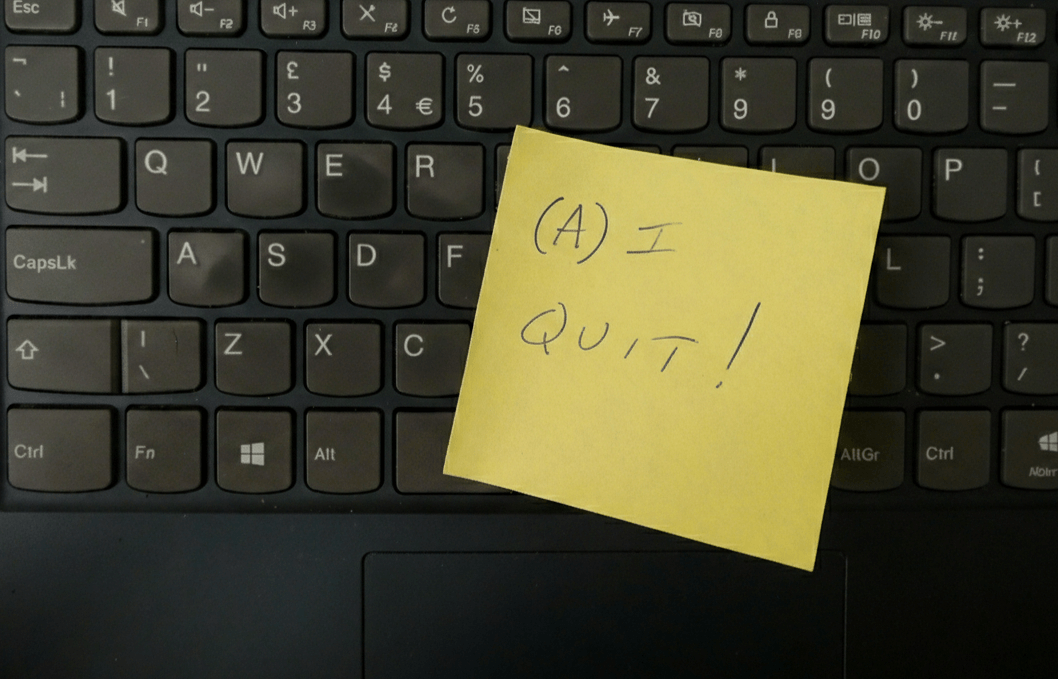
AI is changing the ways in which many of us work and between the debates of efficiency gains and job security, a quieter tension called “employee cracking” has begun to surface.
Struggling with changing expectations, processes and job requirements, workers feel pushed toward disengagement, and are even quitting their jobs altogether. Forbes has described the events as a “technology driven identity crisis”.
Using recent statistics, real-life examples and insight from our Chief Operating Officer (COO) Stephanie Davis Neill, we’ll explore this workplace challenge and explain why and how sustained employee engagement is the key to keeping talent intact.
How AI is being used in the workplace
AI is influencing how workforces complete tasks, generate ideas and even access information. Recent research exploring the AI habits of US workers has found:
- 45% use AI for work at least a few times per year, rising by 5% between the second and third quarters of 2025.
- People are most often using AI to consolidate information (42%) or generate new ideas (41%).
- 61% are using chatbots or virtual assistants, while 36% use AI writing and editing tools and 14% use AI coding assistants.
AI anxiety
With any new technology or innovation comes a level of uncertainty. For those who don’t report using AI in their role, Gallup found that nearly half (44%) don’t believe that AI can assist with the work they do, indicating that many people are not being made aware of how it could benefit their work. Interestingly, 8% said they didn’t feel safe using AI tools.
“The anxiety around AI takes so many shapes because there are a lot of unknowns”, our COO Stephanie Davis Neill explains. Employee anxiety may surround questions such as:
- What can I use AI to do?
- What information shouldn’t be shared with an AI?
- How do I protect PII (Personally Identifiable Information) data?
- How will my job change?
- Will I be replaced?
- When will my robotic vacuum start to look like Rosie from the Jetsons?
“I am kidding about that last one, but the list goes on, and reasonably, no employer or HR leader can be expected to be able to answer all of these questions at once, which can lead to these feelings of uncertainty from employees”, Stephanie says.
Even though conversation about AI has been bubbling up for some time, we have seen teams often surprised by how it just seemed to ‘show up’ one day, with new tools, policies and big shifts in priorities.
– Stephanie Davis Neill, Chief Operating Officer
Is AI making employees quit?
As workplaces begin to mandate AI use, Gallup reports that US employee engagement is falling to rates not seen in 10 years. Satisfaction levels have reached an all-time low, and workers are hunting for new roles at the highest rate in a decade.
- Global employers face a similar challenge, with engagement levels dropping for the first time since 2020, estimated to cost the economy $438 billion in lost productivity.
- Job quit rates reveal March as the most common month for employees to resign.
Is AI a solution to lost productivity, or are usage mandates the very thing driving employees away? Employers may be disconnected from the reality of the situation. Only 4% of employers report employee resistance as a barrier to AI, yet in a survey of 4,000 people, nearly a quarter (22%) said that they would be likely to leave a job due to excessive AI use.
Without active engagement and employee involvement, sudden changes to workflows can lead to resignations if employees are dissatisfied with the impact on their work or job function.
Google Trends data shows a recent spike in people considering resigning. We discovered a 10% yearly increase in Americans searching “quitting my job” (7,000 monthly US searches) and a 14% spike in searches for “finding a new job” (6,000 monthly US searches). 4,000 Americans are also looking up the phrase, “I want to quit my job”, while 1,000 are searching “made to use AI at work”.
AlsoAsked data reveals the types of things being searched for in relation to these types of queries:
- “Forced to use AI at work”: People are wondering whether they can get fired for refusing to use AI, if employers can really make them use it and whether they can generally refuse to do things not in their original job description.
- “Quitting my job”: Searches indicate that employees are burnt out and stressed, wondering if their reason to quit is valid, and the employer red flags they should be watching out for.
What social media reveals about AI-driven resignations

Online outlets reveal a growing backlash to workplace AI mandates, with employees openly sharing why they’re quitting on platforms such as Reddit and X (formally Twitter). Analyzing these posts, we identified a few common themes:
- A desire to be included in AI-related discussions with leadership, which could help reduce the feeling that AI use is being “forced.”
- Frustration when poor AI performance is blamed on “bad prompts” from the employee rather than on the tool or process itself.
- Discomfort with developing AI tools and reporting on their performance, due to fears that the systems they train could eventually replace their own roles.
- Preference to spend longer doing something themselves, than producing it more quickly with AI, which many feel produces poorer results and restricts their creativity and brain power.
- Feelings that management has too high expectations of AI, requesting it be used to replace job responsibilities it is not yet capable of completing to a good standard.
Some are exploring new opportunities while staying in their current role, whereas others are leaving their jobs entirely.
One Redditor who works in engineering shared that being forced to use AI makes her want to leave the industry altogether, not just her current job role. In her post, which received over 600 upvotes, she states that AI has been the most negatively disruptive “trend” in her 15 years in the industry. The poster explains how she doesn’t feel the benefits justify the means as her output is slower and weaker as a result. Commenters on the post also express frustration, slowed productivity and concern about AI replacing human skills.
Another worker feels forced to quit their position in hospitality following changes to the company’s shift scheduling platform. It is now run by AI, continuously putting them on unreasonable shift patterns that management cannot override.
Some people report misrepresenting their use of AI to meet workplace expectations, even though they are completing the work themselves:
- An employee received a poor performance evaluation for the first time for failing to use AI and was encouraged by their manager to conduct “meaningless” chatbot interactions to meet internal reporting standards and boost their AI use score.
- In a thread about coping with mandatory AI at work, multiple people admitted to exaggerating or fabricating their AI usage. One commenter added that while AI is still trending, they feel unable to convince their management they’re better off without it – instead, they pretend to use it and even invent time-saving figures.
We’re hearing a lot of Board-level pressure around AI adoption which trickles down to all teams. But the challenge is having a clear reason why you’re adopting AI, what business gains you’ll actually make, how you’ll measure that, and making sure you have the right foundations around data and your systems to support these goals.
Otherwise, AI becomes more noise that makes the everyday harder. That drives talent away.
– Christine Marino, Chief Strategy Officer
How AI-driven industries feel about working with AI
AI use is soaring across workplaces in the US, and globally, but some industries are moving ahead faster than others. According to a Gallup report, this is primarily knowledge-based industries such as technology and professional services. Researchers found that 76% of technology or information systems employees and 57% of professional services employees used AI in their role a few times a year or more.
The US professional services industry employs over 11 million workers, accounting for 36% of the industry’s global market share, while computer and information technology employment is projected to grow much faster than the average occupation in the next 10 years. DoubleTrack research shows AI hiring trends outpacing data roles, a potentially alarming trend.
Stanford’s AI Index report shows a significant increase in these industries requiring AI skills from new hires. Looking at the difference between 2023 and 2024 US job postings, the study found:
- AI labor demand in the information sector has grown by 79.56%
- AI labor demand in the professional, technical and scientific services sector has grown by 31.2%
AI use in the professional services industry
The “Big Four” accounting firms in the professional services industry are increasingly integrating AI into day-to-day work. Ernst & Young (EY) has rolled out tools to help employees understand how AI will change their roles, and nearly 100,000 employees have earned a digital “AI badge” through new learning programs. Deloitte and EY are also using autonomous AI to handle routine client tasks, such as uploading tax documents, while employees focus on more complex work.

However, in a Reddit thread of alleged employees and ex-employees, one commenter described the AI they’re using as a “glorified search engine” with another sharing how they used it to order pizza to the office.
Company Glassdoor reviews show a mixed reception towards AI developments. There are quite a few reviews highlighting AI use as a positive, especially around AI skill development. Though, significant concerns are apparent:
- One employee refers to tools as “AI Big Brother”, negatively mentioning having daily screen time tracked down to the minute.
- A managing director suggests that the “standard consulting pyramid is at risk of falling apart” due to both AI and their company’s apprenticeship model.
- Multiple reviewers stated that uptake of AI was too slow and that leadership lacked the technical skills needed.
- A few employees also mentioned AI not being used efficiently, with a senior manager noting that their company is “struggling to implement AI and get the right tools to make people successful”.
AI use in the information and technology industry
IT and technology companies are leading the way in developing AI, with employees often the first to gain expertise in emerging tech. Yet surprisingly, this doesn’t seem to be translating into how AI is being used in the workplace.
“We keep seeing a lot of focus – as it should be – on guardrails, security, and expectations. There’s a reason a lot of AI pilots have failed, often because the underlying architecture or processes weren’t ready. Our approach has been very intentional to avoid this.”
– Nick Kollinger, Head of Product at Click Boarding
A survey of over 1,000 senior IT and line-of-business professionals found that many AI initiatives are being abandoned before they reach production – increasing from 17% to 42% year-on-year. 46% of those investing in generative AI reported that no single enterprise objective had seen a “strong positive impact” from that investment.
Our analysis of Glassdoor reviews, covering the top ten IT and technology employers in the US, identified a similar pattern – while many employees value the AI projects they get to work on and contribute to, they are unhappy with how AI is integrated into their daily workflows:
- A software developer says that leadership’s use of generative AI in emails and communications is obvious, which can seem impersonal and unprofessional.
- There is a general consensus that pace and work quality is changing with the introduction of AI processes – one developer states that deliverables have felt rushed since AI was introduced with quality of work decreasing.
- Some reviews suggest that those who do not engage with, or believe in, AI, face worsened career prospects.
- One review states, “If it was up to this company they would sack everyone and use AI”, expressing dissatisfaction with how people versus machines are being valued.
Making your teams feel like they’re living is a lie is a great way to run them away; yet that’s what many companies touting AI capabilities and gains are doing when their teams are drowning in noise while trying to change how they work to meet executive demands.
Start small. Encourage experimentation and failure. But be realistic – your employees need time to transition just as AI continues to evolve at a rapid rate. Rushing this only leads to confusion … or worse, losing great talent.
– Christine Marino, Chief Strategy Officer
Keeping employees engaged when AI changes the workplace
As we’ve learned, AI implementation can be disruptive to the workplace, but careful management of this process will help minimize the risk of employee dissatisfaction, disengagement and even resignations.
Just like AI must learn, so do the employees working with it. It is a process, not just a switch to turn on.
– Stephanie Davis Neill, Chief Operating Officer
Stephanie explains that successfully managing this relies on HR’s traditional role in guiding change: “The rapid adoption of AI has many employees, and organizations for that matter, feeling like everything is spinning. But even before AI, change management has always been one of the most challenging aspects of running a business, especially for HR professionals who are often looked at to lead these efforts.
“Transparency and collaboration are key parts of this process. In fact, AI adoption can be higher when employees get to test or play with AI tools to figure out the best ways they can work with AI to improve their own personal working experience. Just like AI must learn, so do the employees working with it. It is a process, not just a switch to turn on.”

Some of the ways we have been helping companies we work with combat retention problems and the risk of employee disengagement include:
- Sharing important information early in the new hire process, sometimes with video content, to set expectations early.
- Updating compliance-driven policies to include new AI information and require employees to sign these off electronically to ensure company-wide awareness of any changes.
- Creating new workflows that can be assigned to tenured employees to solidify understanding.
Providing an outlet to address frustrations
Social media and public review platforms are often a last resort for employees who feel they have no other outlet to share their concerns. While no organization wants negative perceptions to go public, without effective internal feedback channels, employees may feel their only option is to voice frustrations externally.
Stephanie recommends building trust by asking questions before challenges arise to demonstrate genuine awareness of what is being shared through real action: “When you ask a new hire how they feel before they even start a new job and then continue to talk with them, they are more likely to open up later.
“Conversely, there are many reasons that employees leave organizations, and even when there are lingering issues, keeping that same feedback door open during offboarding can provide an alternative outlet to sharing that feedback publicly.”
Don’t let AI drive your employees away
As AI technology develops, it will undoubtedly continue to reshape the workplace. But, for organizations that embrace learning, collaboration and feedback, it doesn’t have to be something that pushes employees out of the door.
By focusing on engagement, managers and HR teams can help employees feel empowered rather than sidelined, keeping talent intact as how they work continues to evolve.
Support your team through AI changes
We know that change doesn’t always go smoothly. Click Boarding makes it easier to maintain engagement and react to feedback while guiding employees through AI-driven updates:
- Pre-Day 1 Onboarding Workflows: Set new cultural expectations, direct employees to training and gather information about skills or interests as AI reshapes roles – all before their first day, leading to faster ramp times.
- Predictive Indicator Question Sets: Easily deployed throughout all Click Boarding products, from Preboarding through Offboarding to capture sentiment throughout the employee lifecycle.
- Real-Time Insights: Use our built-in dashboards or export data to your own analytics platforms to understand risk areas and feedback as it happens instead of waiting 12 to 18 months for a company-wide survey.
Learn more about our features and see what’s the best fit for your organization.
References
All research for this article was conducted during January 2026.
- Monthly Google Trends data is based on December 2025 to January 2026 and uses US search demographics.
- All company reviews posted on Glassdoor in the past three years mentioning “AI” or “artificial intelligence” were reviewed. Industry analysis included:
- The four largest professional service companies globally (due to there being many subsectors within this space).
- The ten largest employers within IT and technology in the United States.
- Social media examples are drawn from public posts on Reddit and X and represent unverified, self-reported experiences.
Have questions about this article? Email marketing@clickboarding.com.